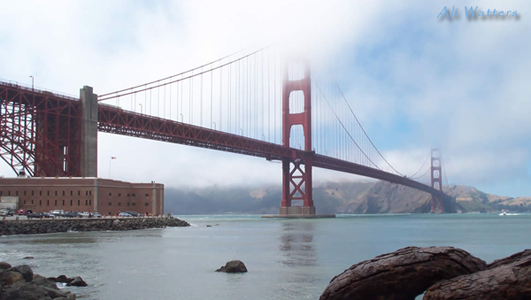
"Of all the cities, where the Hi-Lo's have performed, San Francisco is the most beloved. We found our voice there!"

One of the most innovative jazz/pop vocal groups of all time, the pioneering Hi-Lo's influenced countless pop, R&B, and doo wop groups from the '50s right up to the present.
They formed in December 1953 when Gene Puerling of Milwaukee and friend Bob Strasen Joined with Clark Burroughs and Bob Morse. The latter two were vocalists with the Encores, the vocal group for the Billy May Band. When Billy's band stopped traveling, the Hi-Lo's were born. Reportedly named because of their extreme vocal and physical ranges (Strasen and Morse were tall, Gene and Clark were short), the Hi-Lo's practiced at Clark and Gene's Los Angeles apartment, refining their revolutionary voicings. The group were themselves influenced by such artists as The Four Freshmen,The Skylarks, The Modernaires, Mel Torme's Mel-Tones, and , of course, The Encores, from Billy May's band,
With Clark on lead, Bob and Bob on tenors, and Gene on bass, the Hi-Lo's fractured the traditional definition of vocal group structure with a tonal blend rarely equaled by any quartet.
In 1954, the group came in contact with orchestra leader Jerry Fielding, which initiated their recording career. Fielding wrote the first four band arrangements for the group forTrend Records.
During their formative stage, they performed as a production group at the Sahara Hotel, Las Vegas, backing up various artists including Italian actress/singer Anna Maria Albergetti. The Hi-Lo's did very few backup chores in years to come. As a matter of fact, their only other performing collaborations were on record - one on an early single forHerb Jeffries on Trend, the Columbia records album "Ring Around Rosie" with Rosemary Clooney, and one with Dean Martin on Reprise.
The group's first big performance gig was at Fack's in San Francisco on Market Street, in 1954. They were held over for many weeks and from there it was on to the worldwide jazz club scene.
In the spring of 1954, their recording of "My Baby Just Cares for Me" (Trend) became their first and only chart single, reaching number 29, but pop singles for the emerging rock and roll generation were not what the Hi-Lo's were about. A Billboard review of "Too Young for the Blues" (Starlite) from March 10, 1956, summed it up: "The top swing vocal group has yet to find itself a piece of mass market material, but this attractive side will register with the faithful."In the mid-'50s, the group's star rose when Judy Garland took them on tour and presented their new singing style to a wide audience.
Their audience was a more sophisticated album-buying public that appreciated the intricacies and splendor of their harmonies and arrangements.
Their first LP, Listen (Starlite) in August of 1955, was a landmark of fresh musical interpretations that led to 26 more LPs over the next nine years from such companies as Columbia, Reprise, and Kapp.
IIn 1959, Don Shelton became their only replacement member after Bob Strasen left. Between 1962 and 1981, the quartet earned three Grammy nominations and performed in the Jack Lemmon film Good Neighbor Sam. They appeared on such TV shows as "The Andy Williams Show," "The Steve Allen Show," and put in an amazing 39 performances on Rosemary Clooney's TV show. In 1962, the group made their last appearance performing at the Tropicana Hotel in Las Vegas. When rock and roll eclipsed their traditional audience, the Hi-Lo's retired in 1963.
Gene went on to produce commercials in San Francisco and, in 1967, left for Chicago to form The Singers Unlimited with Don Shelton. Clark continued singing in studio sessions, arranging and production work, most notably for producer Bones Howe with "The Association". Bob Morse moved to Pacific Grove,Ca, and went into a successful interior design and antique business.
In 1977, the group was asked to perform at the Monterey Jazz Festival and reunited after 14 years. The Hi-Lo's fell back into their unique harmonies as if they were putting on a comfortable pair of shoes. This led to their first recording venture since 1964, the "Back Again" LP in 1978 with Rob McConnell's band and "The Hi-lo's Now" for M.P.S., released in U.S. on Pausa Records.Copyright © 2002 - 2010
The Hi-Lo's.com
During the 80's, The Hi-Lo's became the darlings of the college jazz vocal world, touring extensively throughout the U.S. and Canada at College Jazz Festivals and competitions. They appeared again at the Monterey Jazz festival and travelled to Japan with theModern Jazz quartet, Joe Williams, and Dave Pell's "Prez Conference"....
The last concert was in 1992 at Palm Springs, Ca. for the Betty Ford Foundation. After the performance Gene Puerling regretfully disbanded The Hi-Lo's.